A good interview should show how a candidate listens, clarifies a problem, handles an incomplete file, and agrees on the next action. This original exercise gives you a consistent way to observe that work. It is a suggested assessment, not a validated prediction of performance or a claim about Vita’s internal hiring results.
Define the seat before the interview
Write down what the acquisitions manager will own in your business. Possible responsibilities include seller discovery, reviewing an opportunity with the decision owner, negotiating within approved limits, and recording agreed next steps. Decide which tasks belong to the caller, lead manager, underwriter, and closer. Do not ask a candidate to demonstrate authority you would not actually give the role.
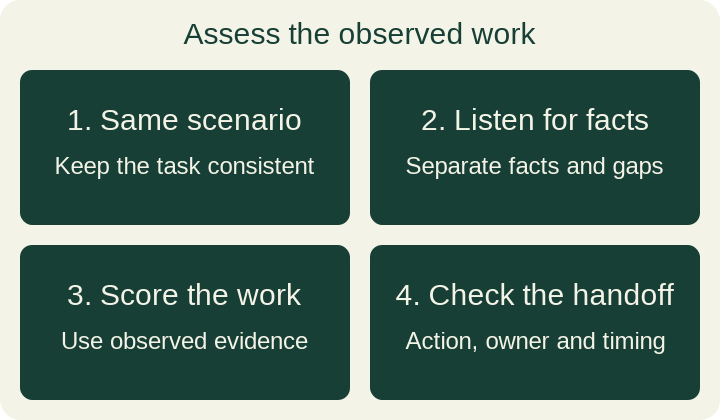
Give everyone the same fictional file
A seller is considering selling a vacant property. The file has an unconfirmed condition note, no verified comparable sales, and a request to close quickly. The seller has spoken with another buyer but has not described the terms. Your candidate has a short discovery conversation before bringing the opportunity back to you.
Allow the candidate to read the file and ask clarifying questions. Explain what they can and cannot promise. Use an interviewer acting as the seller, not a real seller or an undisclosed recorded client. Do not include a client’s personal data.
Observe four parts of the conversation
- Discovery: Does the candidate establish the seller’s goals, timing and missing facts without inventing an answer?
- Judgment: Do they identify what must be verified before discussing a firm commitment?
- Communication: Do they explain their reasoning plainly and respond to the seller’s actual question?
- Follow-through: Can they summarize what was agreed, who owns the next step, and what belongs in the CRM?
Use a simple scoring anchor
| Score | Observable evidence |
|---|---|
| 1 · Needs support | Misses a material question, fills an information gap with an assumption, or ends without a clear next step. |
| 2 · Developing | Finds some missing facts and proposes a next step, but needs prompts to explain limits or ownership. |
| 3 · Ready for the defined task | Clarifies the relevant unknowns, stays inside the stated authority, and records a usable handoff. |
Score each of the four parts separately. Write one observation beside each score. The numbers organize a discussion; they do not establish a universal passing threshold. A strong total should not conceal a serious issue such as an unsupported promise.
Ask for the handoff
After the role-play, ask for a short CRM note containing confirmed facts, unanswered questions, the seller’s stated goal, the next action, its owner, and the agreed timing. Compare that note with the actual conversation. A clear conversation followed by a misleading record is a different hiring concern from a candidate who needs delivery coaching.
Make the decision in context
Use the same core exercise and job-related criteria for each shortlisted person. Explain any changes to the task. Discuss a candidate’s reasoning and the support your role actually provides. Combine the exercise with appropriate references and relevant experience rather than treating one simulated call as proof of future results.
Before hiring, agree on the first-month outcomes, decision limits, coaching owner and escalation path. The assessment is useful only when it resembles the seat the person will actually do.
Connect the interview to the next handoff
After the role-play, use the seller follow-up handoff checklist to review whether the candidate recorded the next action, owner and timing. If the seat also touches buyer follow-up, compare its boundaries with the separate disposition manager work sample. These worksheets describe different tasks; they are not interchangeable hiring tests.
Keep building the operating plan
Use Vita’s interview scorecard and first-month onboarding guide to connect evaluation to the actual job. These are additional Vita resources, not independent validation of this worksheet.